
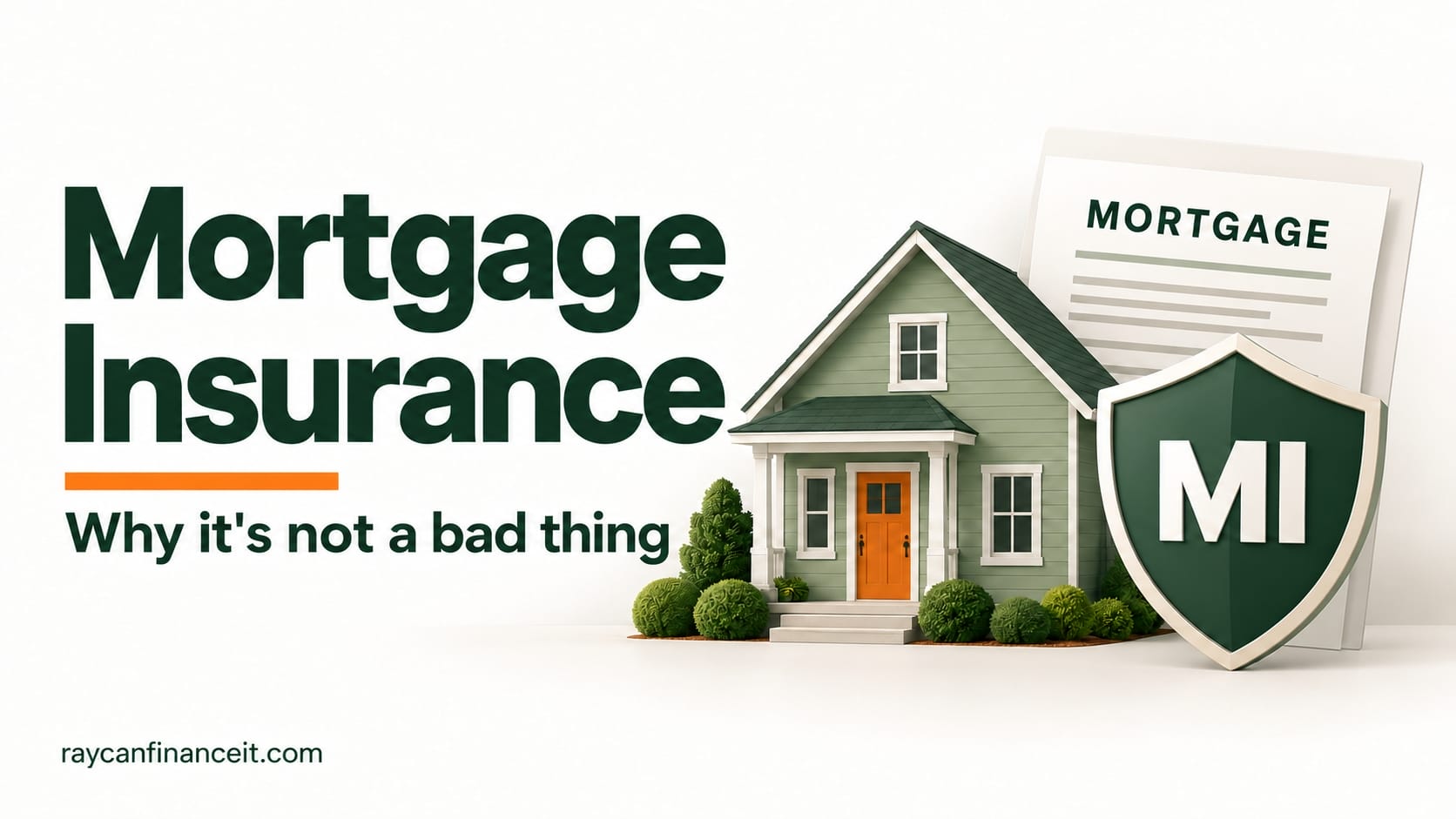
Why Mortgage Insurance Isn’t a Bad Thing
For many homebuyers, the words “mortgage insurance” immediately sound negative. After all, it is an additional monthly expense that does not directly pay down your loan balance. Because of this, many buyers spend years trying to save a 20% down payment simply to avoid it.
The reality is that mortgage insurance has helped millions of Americans become homeowners years earlier than they otherwise could have. In many cases, paying mortgage insurance is actually a smart financial decision.
What Is Mortgage Insurance?
Mortgage insurance is a fee paid on certain mortgage programs when a borrower has a smaller down payment. It protects the lender against losses if the borrower defaults on the loan.
While borrowers pay for the coverage, the benefit is that lenders are willing to offer financing with significantly lower down payment requirements.
Without mortgage insurance, most buyers would need to bring much larger down payments to the closing table.
A Brief History of Mortgage Insurance
Before mortgage insurance existed, buying a home looked very different than it does today.
In the early 1900s, it was common for lenders to require down payments of 30% to 50% of the home’s value. Loan terms were often much shorter as well, sometimes only five to ten years. This meant that homeownership was largely reserved for wealthier families who had substantial savings.
Following the Great Depression, policymakers began looking for ways to make homeownership more accessible.
The creation of the Federal Housing Administration (FHA) in 1934 helped establish long-term fixed-rate mortgages with lower down payment requirements. Later, after World War II, the VA loan program helped returning veterans purchase homes with little or no money down.
Private Mortgage Insurance (PMI) emerged as a way for conventional lenders to safely offer mortgages with smaller down payments. Instead of requiring every borrower to save 20% or more, lenders could transfer a portion of the risk to mortgage insurance companies.
This innovation dramatically expanded homeownership opportunities throughout the United States.
Mortgage Insurance Today
Modern mortgage insurance comes in several forms depending on the loan program. Let's take a look at a few of these:
Conventional Loans
Conventional loans use Private Mortgage Insurance (PMI) when a borrower puts down less than 20%.
PMI has many vendors and a wide range of pricing. Your loan officer can often shop on your behalf for the cheapest rate of PMI. This is different from government programs that have fixed insurance rates. Factors include your amount of down payment, credit score, and area you are purchasing in.
It's also important to note that PMI unlike other mortgage insurance, can be removed from your loan once you've reached 20% equity in your home.
FHA Loans
FHA loans, a common choice for first-time homebuyers, use Mortgage Insurance Premiums (MIP).
These loans are designed to help buyers with lower down payments and more flexible credit requirements. FHA mortgage insurance helps support the program while allowing borrowers to purchase homes with as little as 3.5% down.
The rate for MIP is set by the government and the same for every lender. The annual charge is .55%. There is also a one-time upfront premium of 1.75% that is financed into the loan amount.
USDA Loans
USDA loans technically do not have mortgage insurance. Instead, they require a Guarantee Fee that functions the same way.
These loans offer 100% financing in eligible rural areas and generally have lower monthly mortgage insurance costs than many other low-down-payment programs.
Similar to FHA, USDA's guarantee fee is set by the government. The annual rate is .35% and the upfront financed amount is 1.0%
VA Loans
VA loans also do not use mortgage insurance. Instead they have a funding fee. The VA loan offers 100% finances to Active Duty, Reservists, and Veterans of the US military.
The funding fee is the most unique of all of the insurances mentioned in this article because it is a one-time premium. There is no annual fee that's collected through the mortgage payment.
This fee is also set by the government, financed into the loan amount, and ranges from .5%-3.3% depending on how the loan is being used. Additionally, the Funding Fee can be waived for Veterans receiving more than a 10% disability rating fora service-connected disability; as well as surviving spouses.
Looking at the Effective Interest Rate
One of the biggest mistakes buyers make is focusing only on the interest rate while ignoring the overall cost of financing.
A better approach is to look at the effective interest rate.
This means combining the interest rate and the mortgage insurance cost to determine the true borrowing cost.
FHA Example
Imagine a borrower obtains an FHA loan at 6.00%.
Current FHA annual mortgage insurance is generally 0.55% for most borrowers.
Effective borrowing cost:
6.00% Interest Rate
+ 0.55% Mortgage Insurance
= 6.55% Effective Cost
Conventional Example
Now imagine a borrower obtains a conventional loan at 6.50%.
Their PMI cost is 0.25%.
Effective borrowing cost:
6.50% Interest Rate
+ 0.25% PMI
= 6.75% Effective Cost
At first glance, the FHA loan appears to have a significantly lower rate. However, once mortgage insurance is considered, the difference becomes much smaller.
This is why mortgage professionals compare the total payment rather than simply comparing rates.
Why Mortgage Insurance Can Be a Good Thing
The biggest benefit of mortgage insurance is time.
Suppose a buyer purchases a $400,000 home with 5% down rather than waiting years to save 20%.
While they may pay mortgage insurance for a period of time, they also begin:
- Building equity immediately
- Participating in home appreciation
- Locking in housing costs
- Avoiding future home price increases
If home values rise while the buyer is waiting to save a larger down payment, they may actually end up needing even more money later.
For many households, mortgage insurance is not an added expense. It is the cost of getting into the market sooner and starting the wealth-building process earlier.
Final Thoughts
Mortgage insurance is often viewed as something to avoid at all costs. In reality, it has been one of the most important tools for expanding homeownership in America.
Without it, many buyers would need to save tens of thousands of additional dollars before purchasing a home.
Rather than asking whether mortgage insurance is “good” or “bad,” a better question is whether the benefits of buying now outweigh the costs of waiting.
For many homeowners, the answer is yes.